• Skip to main content
  • Skip to footer

Access Philanthropy

  • Our Services
  • Our Clients
  • Our Team
  • Funder Profiles
  • Home
  • Contact us
  • Login
  • Logout

Recent Posts

  • (no title)
  • Login
  • Purchase a List
  • (no title)
  • (no title)

News & Resources

The Ultimate Guide to Google Ad Grants for Nonprofits: 2024 Edition

February 27, 2024 by

Google Ad Grants is a philanthropic initiative by Google that provides nonprofit organizations with free advertising credits of up to $10,000 per month on the Google Ads platform. The program allows nonprofits to display their ads on Google Search results pages, potentially reaching millions of people interested in their causes. Essentially, it’s an in-kind donation from Google to help nonprofits raise awareness, attract volunteers, and drive donations.

Nonprofit Tech for Good published a guide written by the Co-founder of Webup! – a Google-certified digital marketing agency focused on the Google Ad Grants Program, where he delve into the Google Ad Grants program, discussing what it is, who is eligible, the application process, creating your first campaign, and going through a Google Ad Grants policy checklist to make sure your account is compliant and would not be blocked.
Read the guide

Filed Under: Toolbox, News & Resources, marketing & messaging

Calculating the Real Costs of Fundraising Events

February 27, 2024 by admin

Last updated on December 27th, 2025

In a Linkedin post, Jim Langley, President at Langley Innovations, asks: Are you counting everything spent to put on your event?

  • Staging costs?
  • Staff costs?
  • Morale costs?
  • Lost opportunity costs?
  • Community building costs?
  • Strategic costs?

Read his entry

Filed Under: Toolbox, News & Resources, date, marketing & messaging, Donor Stats & Anaylsis, Fundraising & Grantwriting

How to have a successful introductory meeting with a funder

February 27, 2024 by

Caroline Altman Smith, Deputy Director of Education for The Kresge Foundation in Detroit, writes: “I think the best introductory meetings are just that—the PO and the nonprofit getting to know each other and having a productive exploration of the fundraising Venn diagram: what the foundation is interested in funding, what the nonprofit needs funding for, and ideally, coming to a common understanding of that middle circle where you have mutual priorities.”

A few tips:

  • Have an Agenda
  • If there is something you want the PO to read in advance, attach it to this email – no longer than two pages.
  • Don’t assume they know much about you
  • Be ready to share key details. What is your North Star goal? How long has the organization existed? How many staff do you have? What’s your annual budget? What are your primary sources of funding? What is your program model and who are you trying to help?
  • Watch the clock.

Read her article

Filed Under: Toolbox, News & Resources, Donor Stats & Anaylsis, Fundraising & Grantwriting

How to Craft Your Organization’s Financial Story

February 26, 2024 by

From Nonprofit Finance Fund

Crafting a financial story requires a shared understanding and interpretation of your organization’s numbers and how this connects to your current and continued mission success. This guide will help you develop your financial story, which can be used to align stakeholder and organizational priorities, navigate leadership transitions, and convey how your programmatic work and finances fit together to create a comprehensive picture of your nonprofit’s impact.

Link to NNF.org

Filed Under: marketing & messaging, Uncategorized, Toolbox, News & Resources

ChatGPT in Philanthropy: Useful?

February 24, 2024 by

A number of recent articles have covered artificial intelligence gone awry: Microsoft’s AI’s strange declarations of love. ChatGPT’s inaccuracies. Midjourney’s odd human portraits with too many fingers and too many teeth. And worse, accusations of plagiarism from both human and AI.

Midjourney is getting crazy powerful—none of these are real photos, and none of the people in them exist. pic.twitter.com/XXV6RUrrAv

— Miles (@mileszim) January 13, 2023


But could ChatGPT in Philanthropy be a Useful Tool for Philanthropic Writing?

Here’s One Way it could: Breaking Writer’s Block

There are certainly a whole host of questions to consider and issues to address when it comes to this newest technological advance. However, there is a useful and ethical way to use the technology for writing purposes, specifically in the philanthropic sector: brainstorming.

You may be familiar with the feeling of blank-page-anxiety. That feeling you get when you have a prompt and a flood of information in your head but no way to funnel that information onto paper. ChatGPT is a powerful tool to bridge that gap.

Create ChatGPT account > Get acquainted > Give a command for a response > Ask bot to revise> Make it your own

Step 1: To use the chatbot you’ll need to first make an account on OpenAI. Using ChatGPT is currently free, although there is an option to purchase a Pro account subscription where you get priority access to the chatbot when it’s overloaded with use and unavailable to free use.

Step 2: Get acquainted with the chatbot. It can be a bit daunting at first and you might not know what to ask. The best way to start is with a question or a command. You could ask, for example, what the Bill & Melinda Gates Foundation does. Then perhaps command the chatbot to write a paragraph about the efficacy of mosquito nets. Really get into the brainstorming mindset here.

Step 3: Once you have an idea of the functionality, you can start asking the real questions.

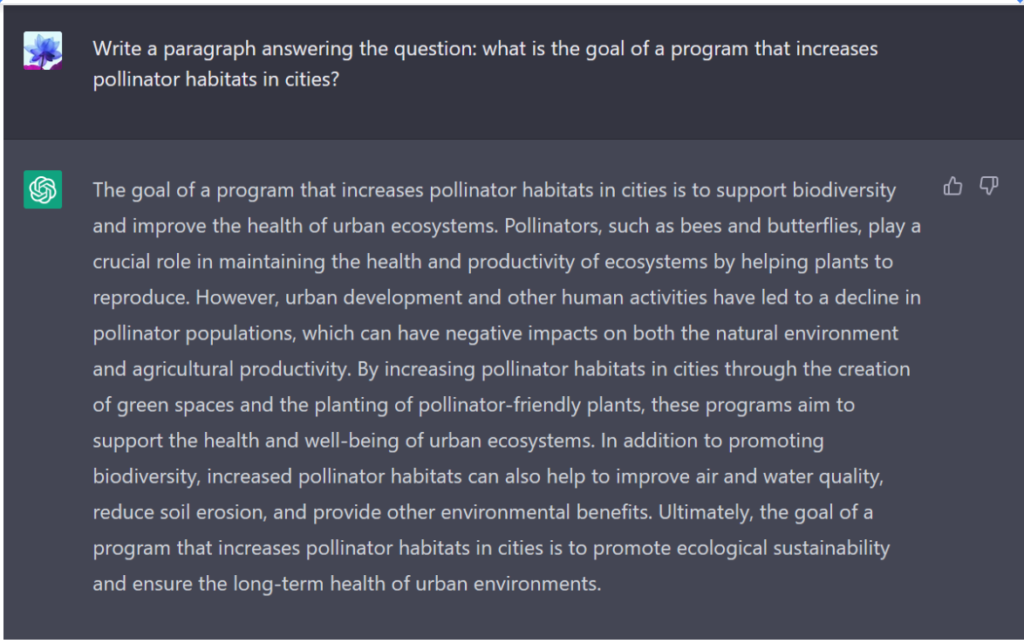
Say for instance you’re writing a grant proposal for a program that would increase pollinator habitats in cities and you’re stuck on that first large daunting question: What is the goal of the project/program?

I asked this very question and received a moderately acceptable response.

Not the worst response, but it could use a bit of pathos and a bit more specificity. The situation might also occur where you forgot a key piece of information or the chatbot didn’t give you exactly what you’re looking for.

Step 4: Ask the chatbot to revise. A useful function of ChatGPT is its ability to learn within the current conversation. If the chatbot didn’t answer the question quite the way you wanted, you can tweak the language or ask it for something specific.

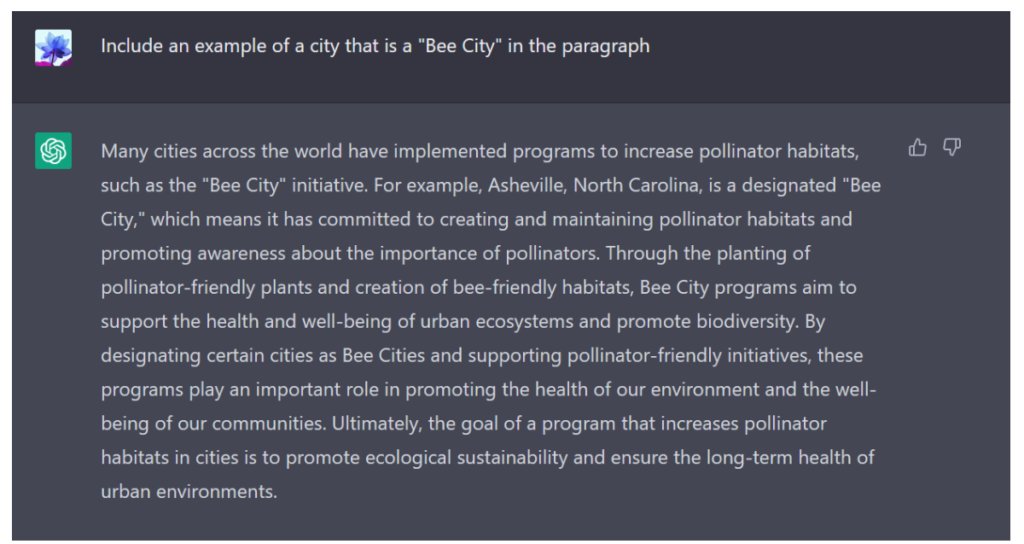
In this example, I asked the chatbot to add an example of a city that is designated as a “Bee City” in the paragraph it had generated.

Step 5: Revise. You may notice the AI also uses certain phrases much more commonly than others, making it sound a bit stiff and a bit one-voiced. These traits are generally unappealing in grant applications or website descriptions; both of which are common time-consuming writing tasks in philanthropy. At the end of the day, you can likely write a more specific and targeted response than the chatbot can, with better pathos. The response is just your starting point.

Say I decide that actually, the first response was a better fit for the direction I want to go in. I might revise it to:

Urban development and other human activities have led to a decline in pollinator populations (bees, butterflies, and the like), exacerbating issues of health and wellness. However, by increasing pollinator habitats in cities through our program, “Save the Pollinators,” we can support the health of the entirety of urban and rural ecosystems, human and nature, through the process of acquiring land and developing land into pollinator-friendly green spaces. Pollinators play a crucial role in maintaining the health and productivity of these ecosystems specifically by aiding plant reproduction. In urban ecosystems this means an abundance of flowers and lush green plants which increase the urban beauty, aid in the mental health of residents, and increase overall the temperature regulation of the area. In rural ecosystems, this means stabilized food production of croplands and an aid in the strengthening of the entire ecosystem, from insects to apex predators. In addition to these benefits, increased pollinator habitats can improve air and water quality and reduce soil erosion.

In this new paragraph, I saved those green highlighted lines but shifted everything else to include some more pathos-centric words and specificity as well as more firmly solidifying a problem-solution narrative. For example, using “urban beauty” and “acquiring land and developing that land.” Had I needed to write this paragraph wholly unaided, it may have taken me a good 30 minutes to complete, needing to go through the task of brainstorming and listing and condensing. With the ChatGPT generated response, I finished in 15 minutes flat, cutting my time in half.

Limitations to remember here: the chatbot won’t have any knowledge of something that doesn’t exist yet, or likely personal details of your organization. In fact, at present, it has limited knowledge of events that occurred after 2021 due to its training data ending in that year.

It also has the ability to make incorrect information sound factually plausible. For example, I asked the AI how many countries start with the letter “v.” The first answer, “There is only one country that starts with the letter “V,” and that is Vietnam,” obviously did not cover every country. I tried again: “There are only two countries that start with the letter “V”: 1. Vanuatu 2. Vatican City (officially known as the Holy See).” Venezuela is nowhere to be found. So that information on Bee Cities? Worth a fact-check.

Filed Under: news, Philanthropy Trends, Toolbox, News & Resources, Fundraising & Grantwriting

Two Great Tools from the Nonprofit Finance Fund 

December 18, 2023 by

The Nonprofit Finance Fund is a NYC-based national nonprofit finance organization, awarding loans, making investments, offering consulting services and workshops, and occasionally offering grant opportunities via other grantmakers. Recently, the Fund published two great grant/loan tools:

  • First, How to Craft Your Organization’s Financial Story. These days, your financial story is probably the most important document you can get a funder who’s not familiar with your work. It’s critical messaging in a way a funder can understand you.
  • Second, Cashflow Projection Template:. Cashflow projections are essential documents for determining how much working capital an organization needs to maintain or build to manage the low cash points in the year.

Filed Under: Toolbox, News & Resources, Donor Stats & Anaylsis, Fundraising & Grantwriting

Six tips on fundraising

July 17, 2023 by

1. Holt Gift Planning on Matching an (In-kind) Asset to The Right Gift Type

Interesting chart matching the type of organization you have with the type of donation a donor wishes to bestow on you. Really a starting point if someone offers you a tractor. Download this Gift Grid:  It’s a quick reference guide for matching non-cash assets with appropriate gift techniques.

2. Nonprofit Finance Fund created a 12-part webinar curriculum on Nonprofit Financial Management Webinars  The series is on You Tube. Download slides and companion workbooks for each webinar from the NFF Website

3. Want to Know More About Peer-to-Peer Fundraising?

  • https://www.qgiv.com/blog/peer-to-peer-fundraising-tips/
  • 10 Peer-to-Peer Fundraising Tips To Help You Raise More

4. Network for Good Best LinkedIn Best Practices for Nonprofits

5. The great people at Propel Nonprofits have lots of good programs. But key for many organizations at this time of year are their lending programs, including a line of credit for late paying committed grants.

6.If you’re looking for child care related lending, our good friends at First Children’s Finance are a GREAT source.

Filed Under: Toolbox, News & Resources, Fundraising & Grantwriting

Saint Paul and Minnesota Foundation: Guide to Donor Advised Funds

July 17, 2023 by

The Saint Paul & Minnesota Foundation has published a comprehensive guide answering common questions about donor advised funds, including:  What are DAFs, why are they increasingly popular, and what should you consider if you’re looking into one?

Link to the guide

Filed Under: Donor Stats & Anaylsis, Toolbox, News & Resources

  • « Go to Previous Page
  • Page 1
  • Page 2
  • Page 3
  • Page 4
  • Page 5
  • Go to Next Page »

Footer

Jobs in Philanthropy
People in Philanthropy
Fundraising Tool Box
  • Access Philanthropy Funder Profiles
  • News & Resources
  • AP Charities
  • Purchase a List
  • Privacy and Policy
  • Login

© Copyright 2025