- Social Impact Infrastructure Organizations (SIIOs) Propel Philanthropy uses the term to identify groups they call “the indispensable backbone for the philanthropic, nonprofit, and civil society sectors”. They are resource builders, conveners, networks, platforms, trainers, educators, researchers, media outlets, and advocates.
- Race Equity Glossary: Maintained by MN Education Equity Partnership, used by several national organizations, coalitions and higher education groups.
- Definitions of Empowerment Language Borealis Philanthropy has published their Glossary Definitions.
- This guide from Disability: walks through the general dos and don’ts when interacting with individuals who identify as disabled
- Racial Equity Tools Glossary SOURCE: Project Change’s “The Power of Words.” Originally produced for Project Change Lessons Learned II, also included in A Community Builder’s Toolkit – both produced by Project Change and The Center for Assessment and Policy Development with some modification by RacialEquityTools.org.
- Meanwhile spaces: Disused sites leased or loaned for a certain period of time by the public sector or developers to local community groups, art organizations, start-ups, and charities. These sites may be vacant or under-used shops, buildings, open spaces, or land. Temporary contracts allow community groups, small businesses, or individuals to pursue economic activity at below-market rates to generate social value for the neighborhood and its inhabitants
- Diversity Dishonesty: hiring a ton of diverse people, putting diverse people on company photographs and advertising assets, but not valuing them in the organization, and then gaslighting when the issue is raised (from According to stylist.co.uk)
- Houseless, unhoused, unsheltered:People are turning away from the most common term, “homeless,” in favor of alternatives. Each one has a slightly different meaning.
- Generosity Experience: your new term for the online solicitation process, as in How to Design a Magical one on Your Nonprofit’s Website
- The Communications Network (the association of grant maker communications people) has a dedicated website directed at how foundation and nonprofit communicators can improve racial equity through their work. The site includes tools to craft relevant messaging that centers diversity, equity, and inclusion, and the results of the 2019 survey of DEI experts. Some of the findings:
- The terms “race” and “racism” rarely appear in organizational DEI definitions, even for organizations focused on justice and equity.
- Respondents rated their organizations’ staffs as more diverse than their boards, and their boards as more diverse than their senior leadership.
- Less than half (42%) of respondents said they had a strong understanding of DEI concepts.
- Over half (57%) saw the impacts of implicit bias present in social good communications.
- Almost half (46%) recognized unintentional reinforcement of stereotypes and an overall lack of understanding of what language should be used in racial equity messaging.
- About one-fifth (21%) of respondents said there was a lack of support for DEI initiatives within the organization.
- BIMPOC – Black, Indigenous, Multiracial, People of Color. This more inclusive term is becoming more popular in philanthropy trade journals
- Third Places – Read the Walton Family Foundation’s opinion piece on funding “third places,” including non-work and non-home places, commercial and public indoor places like bars, restaurants, cafés, barber shops, beauty salons, museums, and libraries, as well as outdoor places like trails and bike paths.
- Latine – There’s a growing debate about the use of “Latinx” as an all-inclusive term for people of all the folks who used to be included in “Hispanics” and “Latinx”. We each get to choose our own names.
- Canopy Gap and Tree Grief – The Star Tribune recently had a piece on how poor neighborhoods have so many fewer trees and shrubbery than wealthy neighborhoods. Evidently, there are some very serious problems when we don’t have enough trees which we call “canopy gaps” or “tree grief”.
- Virtue Signaling – Another old term that’s resurfaced – Mostly intended for corporations or powerful people, “virtue signaling” implies actions taken only to improve their moral reputation. In the early 1990s, it was overused by folks who were pointing out politicos or businesses who did something that looked great that was also hugely visible. It’s back and for good reason.
- Revisiting Capacity Building and Strategic Philanthropy – Sara EchoHawk wrote a nice piece for Nonprofit Quarterly in 2019 on “capacity building” and how many funders use “strategic philanthropy” as code for “overly prescriptive grantmaking”. Both capacity building and strategic philanthropy are back in style. Maybe it’s good to think what each term really means.
- Narrative Change – We debated whether to put this item here, in the Toolbox section or the Survey Says area. Narrative change is a becoming more popular as a distinct and successful tool for advocates and human service people alike. Critical Race Theory and Climate Change stories are two key examples of narrative change. This report, Funding Narrative Change, defines terms, delineates benefits (e.g., funders want to learn), and provides “how to” examples. An important read for people who need to open minds.
Toolbox
12 Ways to Attract New Donors
From Network for Good
Here’s the list. Read More online for details on each
1. Relationship mapping
2. Research, research, research
3. Be where they are
4. Leverage your volunteers
5. Turn your board into advocates
6. Launch a peer-to-peer campaign
7. Host an event
8. Build partnerships
9. Get out in the community
10. Host cultivation parties
11. Cultivate the next generation
12. Maximize corporate partnerships
Best tool ever for fundraising for children and youth orgs
From Anne E Casey Foundation
Theses are Foundation’s signature resources tracking the well-being of children over time and across states in order to provide high-quality, unbiased information and encourage action on behalf of kids and families.
From the Website:
The KIDS COUNT Data Center is an online resource that provides data on child well-being over time from the most trusted national sources and from more than 53 state- and territory-based organizations. The KIDS COUNT Data Center houses hundreds of key child and family well-being indicators and more than four million data points at the national and local levels.
The KIDS COUNT Data Book provides a detailed picture of how children are faring in the United States, ranking states on overall child well-being and domains. The Data Book also contains key indicators covering economic well-being, education, health and family and community. Each year, the release of the Data Book generates significant media attention and a unique opportunity to discuss ways of improving the lives of children and families.
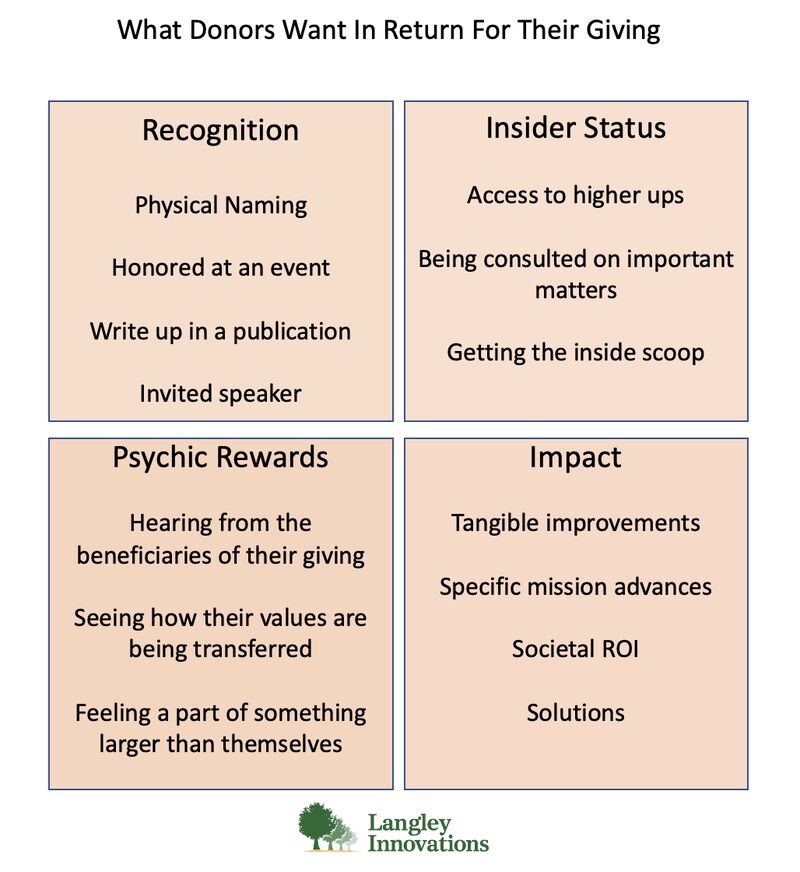
What Donors Want
Graphic from Council for Advancement and Support of Education
The Due Diligence Tool
This 65-page handbook was created by Grantmakers for Effective Organizations, as a blueprint for nonprofits wanting to understand what reviewers are thinking about as they examine requests for support, and how they assessing an applicant and its proposal for funding.
Who Reviews Your Grant Proposals?
From The NonProfit Times
… Who reads, votes, rejects or rewards your effort?
First, consider the size of the staff at the funder you’re approaching. If it’s the Bill & Melinda Gates Foundation, the person-power is close to 1,800. If it’s a community foundation in a major metro area, it might be 50-75 people. For a small private grantmaking foundation, there might be a staff of 10 or even fewer.
- If it’s a very large staff, there are probably program assistants or associates who take a first crack at proposals.
- If it’s a very small foundation, with very few staffers — your proposal might only get one chance.
…there is a body of information that all reviewers probably subscribe to, however informally. Some years ago, a coalition of funders created the “Due Diligence Tool” — a 65-page handbook for assessing an applicant and its proposal for funding. The publication, by Grantmakers for Effective Organizations, is a useful blueprint for nonprofits wanting to understand what reviewers are thinking about as they examine requests for support.
10 Online Fundraising Best Practices for Nonprofits
From: Nonprofit Tech for Good
Here’s the list. Read More online for details on each
1) Implement donation page best practices.
2) Proactively promote your monthly giving program.
3) Launch a tribute giving program.
4) Know the power of email fundraising.
5) Prioritize a matching gifts strategy.
6) Experiment with crowdfunding and peer-to-peer fundraising.
7) Sign up for Facebook & Instagram Fundraising Tools.
8) Embrace cause awareness and giving days.
9) Host online fundraising events.
10) Invest in a customer relationship management (CRM) platform.
10 Peer-to-Peer Fundraising Tips To Help You Raise More
From QGiv
Peer-to-peer campaigns are now one of the most popular fundraisers nonprofits all over the world embrace. In fact, 39% of Americans say they’ve donated to a charity based on a request from a friend or family member.
Here’s the list. Dread more detail about each, online
1. Come up with an idea that fundraisers are excited about
2. Prepare your fundraisers
3. Use branded pages
4. Incorporate social media
5. Ask your fundraisers to set personal goals (and raise them later!)
6. Gamify your event
7. Engage your fundraisers
8. Ask volunteers to use their talents to encourage donations
9. Encourage updates on their progress
10. Have a plan for retaining those first-time donors