• Skip to main content
  • Skip to footer

Access Philanthropy

  • Our Services
  • Our Clients
  • Our Team
  • Funder Profiles
  • Home
  • Contact us
  • Login
  • Logout

Recent Posts

  • (no title)
  • (no title)
  • (no title)
  • Our Team
  • (no title)

news

A Look at Impact Investing

February 24, 2025 by

A trend among some funders at the national, regional & local level is the adoption of impact investing strategies. Foundations and large funders still provide grants, but are blending the “investment” model with traditional grants.

=>see below for a list of Impact Investors in MN

The investment portion aims to produce both financial returns and positive societal change, aligning their capital with market-driven solutions. This shift is largely driven by the desire for sustainable, long-term impact where capital can be reinvested rather than distributed as one-time grants. Some funders see private capital and market mechanisms as more efficient in driving social change compared to traditional charity models. Furthermore, impact investments often come with defined metrics, allowing for greater accountability and transparency in tracking results.

The rise of blended finance models also allows funders to use their capital as catalytic funding, leveraging private sector investments through mechanisms like loan guarantees and program-related investments (PRIs). Regulatory and tax considerations further encourage this shift, as impact investing offers foundations flexible financial options, especially with mission-related investments (MRIs). Foundations embracing this shift include the Ford Foundation, which has committed $1 billion to mission-related investments in areas like affordable housing, and the Rockefeller Foundation, which focuses on climate resilience and healthcare through impact investments. Other prominent foundations, such as the MacArthur Foundation, Kresge Foundation and Omidyar Network, have also committed significant funds to impact investing in sectors like housing, climate solutions, and economic empowerment.

It is important to clarify a funder’s approach—whether they are offering grants, investments, or a blend. Asking about the funder’s expectations for financial returns and reviewing past funding models can provide insight into their approach. Adapting your language to focus on scalability, sustainability, and return on impact can make your proposals more appealing to impact investors.

Here’s a list of Key Impact Investors & Funds in Minnesota

  1. Blandin Foundation focuses on rural impact investing in economic development, broadband expansion, and community resilience. Uses program-related investments (PRIs) to support rural businesses and social enterprises.
  2. Otto Bremer Trust uses mission-aligned investments (MAIs) and grants to support economic development, community resilience, and racial equity. Provides low-interest loans and direct equity investments. 
  3. Bush Foundation provides social impact investments, grants, and program-related investments (PRIs). Focuses on Native communities, leadership development, and community innovation.  
  4. Cogent Consulting & Wealth Advisory is a Minneapolis-based impact investing and ESG consulting firm. Works with investors looking to align their portfolios with social impact goals. 
  5. Community Reinvestment Fund, USA (CRF) is a  Minnesota-based CDFI (Community Development Financial Institution) providing impact investment opportunities. Funds small businesses, affordable housing, and community infrastructure. 
  6. Great Plains Institute (GPI) supports clean energy and sustainable infrastructure projects. Helps investors identify opportunities in renewable energy and climate solutions.  
  7. Local Angel Investor Networks (with Impact Focus) is a Twin Cities Impact Investing Network: Connects investors with mission-driven startups. Gopher Angels invests in Minnesota-based businesses, including social enterprises.
  8. McKnight Foundation is one of the largest impact investors in Minnesota, allocating $500 million of its endowment for impact-focused investments.  Funds clean energy, economic development, and racial equity initiatives. 
  9. MEDA (Metropolitan Economic Development Association) provides capital and investment support for minority-owned businesses in Minnesota. Offers loans, venture capital, and technical assistance. 
  10. Minnesota Impact Investing Initiative (MI3):  A collaboration between the Minnesota Council on Foundations (MCF) and financial institutions to invest in projects that generate both social and financial returns. Focuses on affordable housing, small businesses, and environmental sustainability.
  11. Mortenson Family Foundation invests in climate change solutions, racial equity, and local communities. Provides grants and mission-related investments (MRIs). 
  12. Northwest Area Foundation invests in Native American communities, racial equity, and economic justice. Provides grants and impact investments for economic mobility. 
  13. The Jay & Rose Phillips Family Foundation of Minnesota supports economic empowerment, racial equity, and workforce development. Uses grants and impact investments to create sustainable community change.  
  14. The Saint Paul & Minnesota Foundation engages in impact-first investments to strengthen local communities. Focuses on racial equity, affordable housing, and economic opportunity.  
  15. Social Impact Strategies Group (SISG) is a woman- and BIPOC-led impact investment firm focused on funding local businesses and social enterprises in Minnesota.

Are you interested in learning more about impact investing? Drop us a note — [email protected]. and let us know what you want to know and how it fits into your work.
Filed Under: news, Philanthropy Trends, News & Resources, Fundraising & Grantwriting

Trends In MN Arts Funding

October 7, 2024 by

Top Trends by the numbers in MN Arts Grantmaking

  • The overall # of arts grants rose by 844 from 2018 to 2021, then declined.
  • 2019 and 2020 were High Water Marks, almost every area of arts funding then declined from 2021 to 2022
  • General Operating Support grants in the arts increased by 1,100 grants from 2018 to 2021 but also declined in 2022
  • Grants for “BIPOC” arts is consistently around 20% of total arts giving.

Key Takeaways

  • Performing Arts grants declined by more than 1,000 from 2019 to 2022
  • While General Operating grants went up, Arts Education grants declined.
    • Some arts groups used Education as a substitute for Gen Op, is there a correlation?
  • A closer look at BIPOC arts grants is revealing. For example, in 2021:
    • Total # of BIPOC arts grants: 825
    • # of grants to BIPOC-led groups: 515
    • Latin, African Descent & Asian American arts groups are particularly under-represented in Minnesota arts grantmaking. (See specific tables below.)
  • Cultural Awareness grants are a relatively new area of arts grantmaking, growing from 80 grants in 2014 to 273 in 2022.
  • Surprisingly, grants for Visual Arts nearly doubled from 2018 to 2022.
  • We imagined Arts Services grants would go up during Covid, but they declined by nearly 200 grants in 2020
  • Grants to Museums declined by 201 grants from 2018 to 2022. Certainly, Covid affected this but grants did not recover in 2022. Dominance of a few museums did decline. A ratio of 6 grants for every recipient in 2018 to 4 grants for every recipient in 2022.

All Arts Grants in MN 2018-2022

(Source: Foundation Directory Online)


Grants by Interest Area & Race-Specific Arts

Filed Under: Uncategorized, news, Research, Philanthropy Trends, News & Resources, no sidebar links

10 Words and Phrases You Should Never Use

April 12, 2024 by

An advice piece in the Chronicle of Philanthropy goes after “Philanthro-speak” which often means one thing to a foundation program officer and another to people outside that bubble.

Here are a few terms — suggested by the CP staff as well as nonprofit leaders and communications experts — that may alienate or confuse rather than inspire:

Asset mapping
This is a popular term in community-development work. “Asset mapping,” explains the Local Initiatives Support Corporation on its website, “is a capacity-focused way of reimagining the place-making practice around the strengths and gifts that already exist in our communities.” More simply, the phrase describes the process of cataloging a community’s strengths and resources. A derivation perhaps more confusing: “asset-based framing.”

Best practice
The phrase was first found in Scientific American in the 1920s, according to the Oxford English Dictionary, and burrowed into the business and management consultant fields in the 1980s. It since has migrated to medicine, government, education, and the philanthropy and nonprofit worlds. The problem, experts say: Something is best practice only until research finds something else is indeed better. The phrase also encourages standardization — a one-size-fits-all approach that fights against the philanthropy trend captured by another buzzword: “participatory grant making,” in which communities or individuals closest to a problem are the ones that decide what’s best.

Bridge building
Words from the design or construction fields — including “scaffolding” and “infrastructure” — suggest that philanthropists are expert planners. “Bridge building implies an architecture designed to bring things together that weren’t intended to be together in the first place,” Dean-Coffey says.

Concretize
An authority no less than the Allied Grant Writers advises grant seekers to “concretize your overall idea of a project.” Dictionaries confirm it’s a word — the OED says it dates to the 1800s — but a more user-friendly piece of advice might be: “Offer details to illustrate your project.”

Ecosystem
National Geographic Society, the venerable nature and science nonprofit, calls an ecosystem a “geographic area where plants, animals, and other organisms, as well as weather and landscapes, work together.” Nonprofits often use the term to describe the set of relationships between groups in a network of organizations. The result can be quite confusing. When Deloitte Consulting’s Monitor Group identified 45 roles for community philanthropy organizations, it included those “proactively planning for the long term,” some “building collaboratives,” and others “managing formal collaborations.”

Impact
It’s probably one of the most seemingly benign yet most overused words in philanthropy. Every program officer wants their grants to result in change. But “impact” is something that happens to something; it suggests, for instance, that a community working with a foundation has no role in its betterment, says Jara Dean-Coffey, director of the Equitable Evaluation Initiative, an effort to redefine how foundations determine grant results.

Meteors make impact. Teeth get impacted. The word is “violent, nonconsensual, and not fair,” she says.

Leverage
Tony Proscio, a retired consultant to large foundations, says that too often,  philanthropy leaders use fancy words from other fields that shroud what they really mean. “Leverage,” which is borrowed from the financial world, is “the one I despise the most.”

Socialize
Foundations sometimes say they need to “socialize” a big idea — shorthand for testing whether the people they want to help will embrace the concept. Merriam-Webster’s third definition — “to organize group participation in” — might be appropriate, but the word can strongly suggest training others in established values and habits — in other words, bending others to norms.

Systems change
This phrase typically describes efforts to “tackle the root causes” of a societal issue, not the symptoms. But it’s so dense with connotations that Rockefeller Philanthropy Advisors even wrote a “topic brief” to explain the term (complete with an infographic). Ambitious grant makers reach for “systems transformation.” And when change efforts grow complicated, they require an “orchestration mechanism” to coordinate parties involved.

Theory of change
The authors of a 2004 study commissioned by the Annie E. Casey Foundation suggested that without a theory of change — that is, a plan for how to solve a problem — nonprofits and the people they serve are vulnerable to “wandering aimlessly.”

Enter a foundation, which will present a plan, packaged as a theory of change. Barriers to change will be identified, partners in the work engaged, money will be well spent, and the problem will be managed. But the term suggests a single answer to a problem and a prescriptive approach.

Filed Under: language, news, Philanthropy Trends, Toolbox

FREE information on grant makers

March 29, 2024 by admin

Cause IQ’s is a subscription-based database built for consultants, accountants, and IT firms to find and market to nonprofits. A Cause IQ profile shows Program areas, Funding, Grantmaking, Financials, and Personnel. With the free account, it’s mostly 990 data but MUCH easier to read than the tax form.

Here’s some of what’s in a search with a free account:

First, create a free account. When logged in, you get a Dashboard with a search box.

  • Type in the name of a funder, or, keywords, like “Minnesota Foundations” – that gives you a list of 2,880 organizations, each with a profile.
  • Under “Advanced Search” you see how many are Private foundations, Corporate foundations, etc.
  • Filter on any of these Types, and/or Revenue, and/or City
  • You can save the Search, to return to over time.

The Grantmaking tab offers graphs comparing issues that received funding, the number grants made in what states, the NTEEs, and more. Graphs likes these are behind paywalls on other search sites.

Another pleasant discovery, the Dashboard remembers recent searches, viewed profiles, and lists updates on them.


Give it try: https://www.causeiq.com/

Filed Under: news, Toolbox, Donor Stats & Anaylsis

3M Foundation (aka 3M Gives) Shuts Down

March 25, 2024 by

(3/25/24)
3M Foundation has shut down. Future grants will be awarded through 3M’s corporate giving program.

The 3M Foundation was established 70 years ago. It was one of the first corporate foundations in the U.S. and very well respected in the corporate community. For the last 30+ years, 3M corporation has awarded philanthropic grants through both its foundation and a related corporate giving program.

Historically, the corporate giving program’s grants were more business influenced (STEM, colleges, employees), while the foundation was more focused on arts, human services, and community development.

In 2021, the corporation shifted the foundation’s giving to also focus on STEM and related fields. At the same time, the foundation announced it was no longer accepting unsolicited requests for funding. Then, when the foundation filed its most recent 990 PF (2022), it reported that it was filing its final report, ending operations and turning over its last year’s funding ($11.4 million) to the St Paul and Minnesota Foundation.

3M’s community website reports the company’s most recent total giving (2022) for both programs was $31 million ($11 million from the foundation and about $20 million from the corporate giving program). No word on 2023 giving yet. Please note there are also in-kind donations and other types of giving.

From now on, the corporation will award all its grants and scholarships only through the corporate giving program. We anticipate total 3M corporate giving will decrease in the near future and we wonder if the company may close its giving program for a while. That’s not surprising given the financial problems the corporation has been experiencing for the last few years.

The new 3M CEO, William Brown has experience with corporate giving programs and may want to reorganize the company’s giving programs. We’ll let you know.

Filed Under: news

10 Ways to Boost Fundraising and Attract More Big Gifts This Year

March 18, 2024 by

Excerpt from The Chronicle of Philanthropy
Three seasoned fundraisers share proven tactics — and real examples — to help you adapt your big-gifts strategy to the current climate and maximize results.
By Lisa Schohl
FEBRUARY 13, 2024

1. Focus on midlevel donors.
…because oftentimes, $2,500, $5,000, $10,000 is more accessible than higher-end major gifts, and people are more inclined to maintain their giving to an institution in that regard.

2. Identify gaps in your donor pool.
… such as communities that might have a natural connection to your cause but aren’t yet giving.

3. Diversify your board.

  • Ask corporate partners to recommend company leaders who care about your organization’s mission and might be interested in serving on the board.
  • Consider donors who demonstrate passion for your work.
  • Create a “young patrons’ board.”

4. Tap into big donors’ networks.

5. Maximize your board.

… set clear expectations for their annual giving and involvement in fundraising from the get-go, including asking them to sign a board member commitment form where they could indicate their interest in helping with specific types of donor outreach, such as visits, hosting a gathering, or sponsoring an event.

6. Streamline your donor communications.
… Automate as many processes as you can to help ensure that all donors get attention throughout the year, while freeing up fundraisers to focus on building relationships with big donors and bringing in new supporters.

7. Be vulnerable.
… you don’t want to be existential, but it’s OK to be honest and open with donors about your nonprofit’s need.

8. Highlight gifts to inspire more giving.

9. Use matching gifts to boost results.

10. Prioritize donors who have DAFs or family foundations.
…start by mining the donor database to identify individuals who have given in one of these ways. Don’t wait until November or December to talk with DAF donors- that is when many are focused on adding money to their DAF, rather than distributing it.

Filed Under: Toolbox, Fundraising Tips, Fundraising & Grantwriting, news

Northwest Area Foundation has changed its mission

February 27, 2024 by

Northwest Area Foundation: “The Opposite of Poverty is Not Wealth but Justice”

Northwest Area Foundation has changed its mission to reflect a commitment to put justice at the center of its support of Native Americans, communities of color, immigrants and refugees, and people in rural areas. President Kevin Walker says thriving requires more than material prosperity and barriers cannot be overcome by focusing through only a poverty-reduction lens. “We stand alongside changemakers in our eight states and 76 native nations and fund work that leads to racial, social, and economic injustice.”

Read Walker’s letter

Filed Under: news, Foundation Notes, News & Resources

ChatGPT in Philanthropy: Useful?

February 24, 2024 by

A number of recent articles have covered artificial intelligence gone awry: Microsoft’s AI’s strange declarations of love. ChatGPT’s inaccuracies. Midjourney’s odd human portraits with too many fingers and too many teeth. And worse, accusations of plagiarism from both human and AI.

Midjourney is getting crazy powerful—none of these are real photos, and none of the people in them exist. pic.twitter.com/XXV6RUrrAv

— Miles (@mileszim) January 13, 2023


But could ChatGPT in Philanthropy be a Useful Tool for Philanthropic Writing?

Here’s One Way it could: Breaking Writer’s Block

There are certainly a whole host of questions to consider and issues to address when it comes to this newest technological advance. However, there is a useful and ethical way to use the technology for writing purposes, specifically in the philanthropic sector: brainstorming.

You may be familiar with the feeling of blank-page-anxiety. That feeling you get when you have a prompt and a flood of information in your head but no way to funnel that information onto paper. ChatGPT is a powerful tool to bridge that gap.

Create ChatGPT account > Get acquainted > Give a command for a response > Ask bot to revise> Make it your own

Step 1: To use the chatbot you’ll need to first make an account on OpenAI. Using ChatGPT is currently free, although there is an option to purchase a Pro account subscription where you get priority access to the chatbot when it’s overloaded with use and unavailable to free use.

Step 2: Get acquainted with the chatbot. It can be a bit daunting at first and you might not know what to ask. The best way to start is with a question or a command. You could ask, for example, what the Bill & Melinda Gates Foundation does. Then perhaps command the chatbot to write a paragraph about the efficacy of mosquito nets. Really get into the brainstorming mindset here.

Step 3: Once you have an idea of the functionality, you can start asking the real questions.

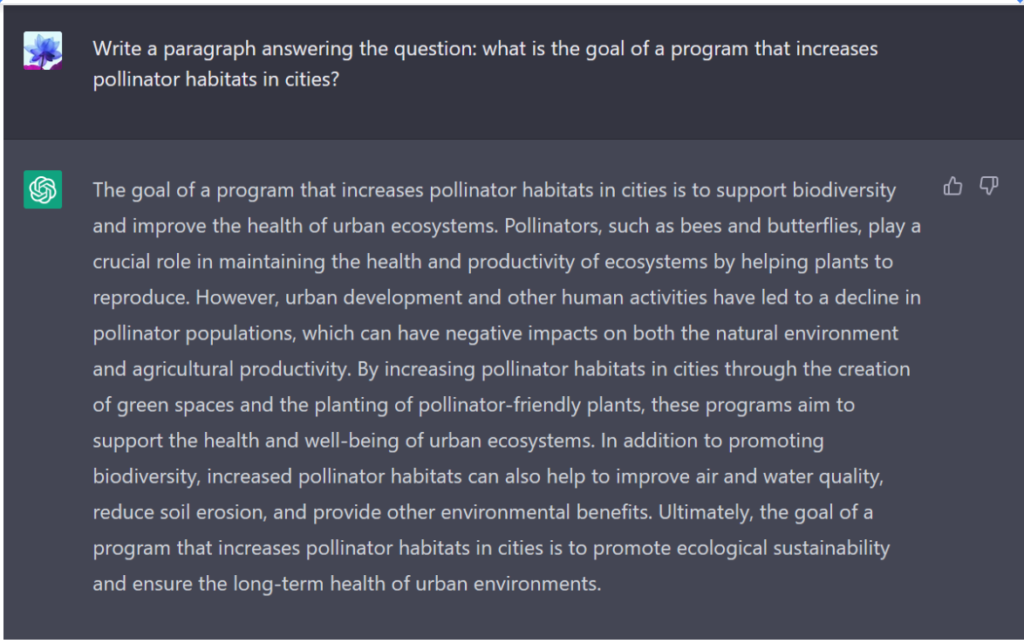
Say for instance you’re writing a grant proposal for a program that would increase pollinator habitats in cities and you’re stuck on that first large daunting question: What is the goal of the project/program?

I asked this very question and received a moderately acceptable response.

Not the worst response, but it could use a bit of pathos and a bit more specificity. The situation might also occur where you forgot a key piece of information or the chatbot didn’t give you exactly what you’re looking for.

Step 4: Ask the chatbot to revise. A useful function of ChatGPT is its ability to learn within the current conversation. If the chatbot didn’t answer the question quite the way you wanted, you can tweak the language or ask it for something specific.

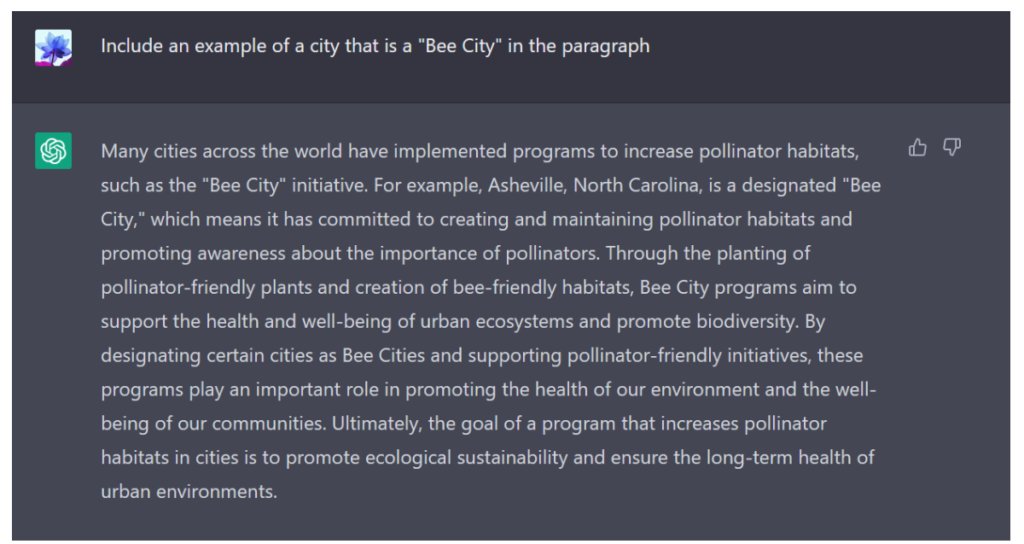
In this example, I asked the chatbot to add an example of a city that is designated as a “Bee City” in the paragraph it had generated.

Step 5: Revise. You may notice the AI also uses certain phrases much more commonly than others, making it sound a bit stiff and a bit one-voiced. These traits are generally unappealing in grant applications or website descriptions; both of which are common time-consuming writing tasks in philanthropy. At the end of the day, you can likely write a more specific and targeted response than the chatbot can, with better pathos. The response is just your starting point.

Say I decide that actually, the first response was a better fit for the direction I want to go in. I might revise it to:

Urban development and other human activities have led to a decline in pollinator populations (bees, butterflies, and the like), exacerbating issues of health and wellness. However, by increasing pollinator habitats in cities through our program, “Save the Pollinators,” we can support the health of the entirety of urban and rural ecosystems, human and nature, through the process of acquiring land and developing land into pollinator-friendly green spaces. Pollinators play a crucial role in maintaining the health and productivity of these ecosystems specifically by aiding plant reproduction. In urban ecosystems this means an abundance of flowers and lush green plants which increase the urban beauty, aid in the mental health of residents, and increase overall the temperature regulation of the area. In rural ecosystems, this means stabilized food production of croplands and an aid in the strengthening of the entire ecosystem, from insects to apex predators. In addition to these benefits, increased pollinator habitats can improve air and water quality and reduce soil erosion.

In this new paragraph, I saved those green highlighted lines but shifted everything else to include some more pathos-centric words and specificity as well as more firmly solidifying a problem-solution narrative. For example, using “urban beauty” and “acquiring land and developing that land.” Had I needed to write this paragraph wholly unaided, it may have taken me a good 30 minutes to complete, needing to go through the task of brainstorming and listing and condensing. With the ChatGPT generated response, I finished in 15 minutes flat, cutting my time in half.

Limitations to remember here: the chatbot won’t have any knowledge of something that doesn’t exist yet, or likely personal details of your organization. In fact, at present, it has limited knowledge of events that occurred after 2021 due to its training data ending in that year.

It also has the ability to make incorrect information sound factually plausible. For example, I asked the AI how many countries start with the letter “v.” The first answer, “There is only one country that starts with the letter “V,” and that is Vietnam,” obviously did not cover every country. I tried again: “There are only two countries that start with the letter “V”: 1. Vanuatu 2. Vatican City (officially known as the Holy See).” Venezuela is nowhere to be found. So that information on Bee Cities? Worth a fact-check.

Filed Under: news, Philanthropy Trends, Toolbox, News & Resources, Fundraising & Grantwriting

  • Page 1
  • Page 2
  • Page 3
  • Go to Next Page »

Footer

Jobs in Philanthropy
People in Philanthropy
Fundraising Tool Box
  • Login
  • Access Philanthropy Funder Profiles
  • News & Resources
  • AP Charities
  • Purchase a List
  • Privacy and Policy

© Copyright 2025